Note: Jupiter has shadow transits all the time (the planet's equatorial plane (where most of the moons orbit) never gets so inclined that the shadowing moons' shadows miss the planet (much).
See a Shadow Crawl across Saturn's Face
Saturn only gets shadow transits when it's equatorial (and ring plane) is aligned with the ecliptic - around its equinoxes occuring equidistant (equi-temporal, really) in its 29-year orbit. Only Titan is large enough to cast a shadow large enough for modest amateur telescopes (it's the second largest moon in the solar systems and the second moon to get a lander on it).
So one advantage of Saturn looking it's dullest (it's rings are nearly edge-on) is that we can see Titan's shadow. Note: Titan is almost always visibile in a telescope - even small ones.
You'll need a telescope, but not necessarily a good one. But go out early to see if you can see Saturn clearly (well before the transit occurs). Saturn rises around sunset, so as soon as it clears the murk of the low horizon in the southeast, take a look. You do NOT need to find a dark sky: the planets' brightness shines through urban light pollution pretty well.
When
Friday September 19, 2025 - (past - Google "Titan Shadow Transit" to find the next transits)
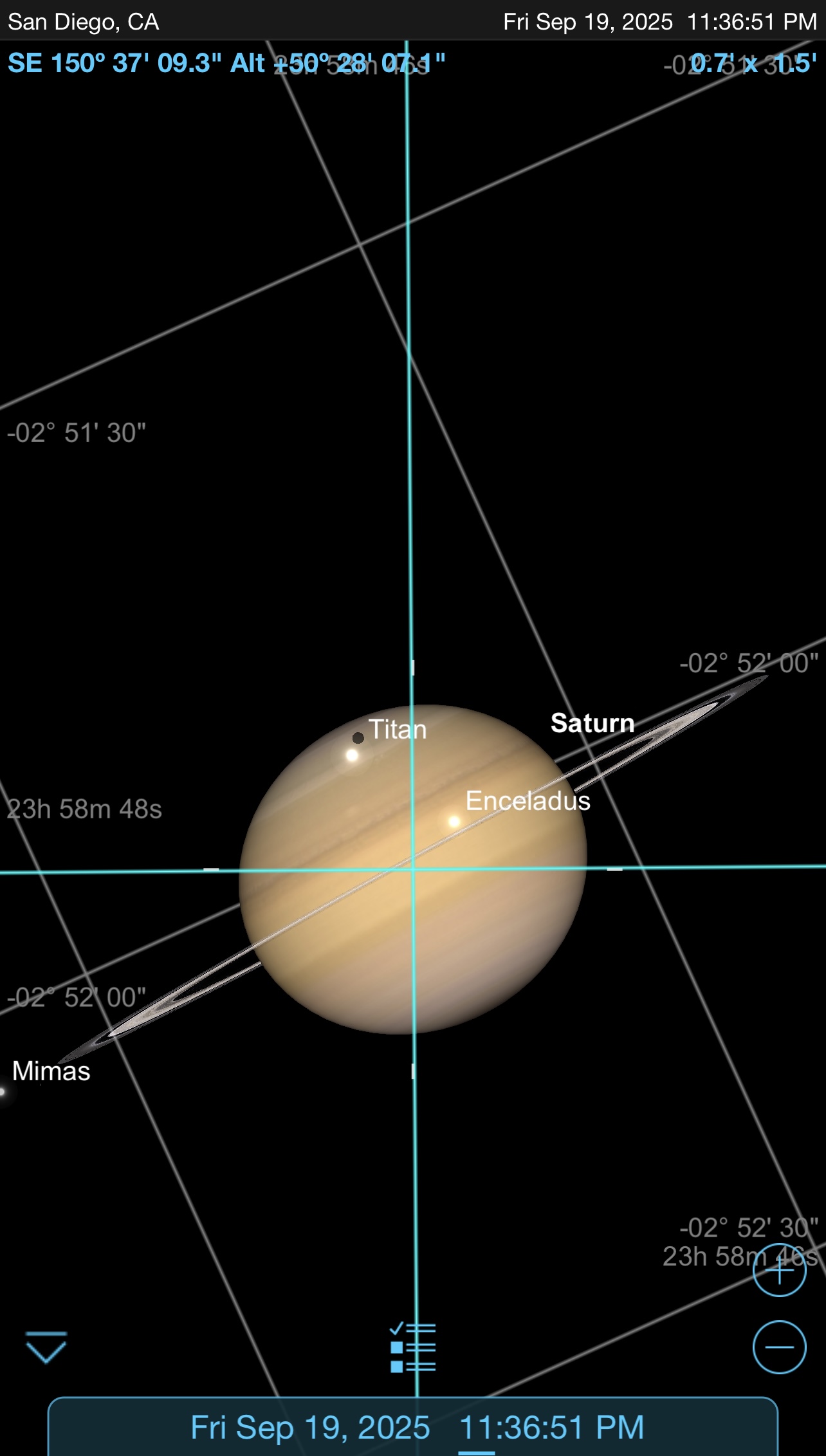
Friday Night around 11:30p PDT (UTC - 7) (Saturday Morning 2:30a EDT) Titan's shadow is about halfway across the face of Saturn. As shown below.
The shadow ingresses the limb of Saturn at around 10:00p and egresses at around 12:30a. If you observe any time in between, you should be able to see Titan's shadow.
The rings are nearly edge on, so the jaw-drop Saturn effect is at a minimum.
Small scopes of decent quality will show the shadow, but only higher optics would allow seeing Titan against Saturn's face.
Screenshot from Sky Safari near mid-transit:
Finding Saturn
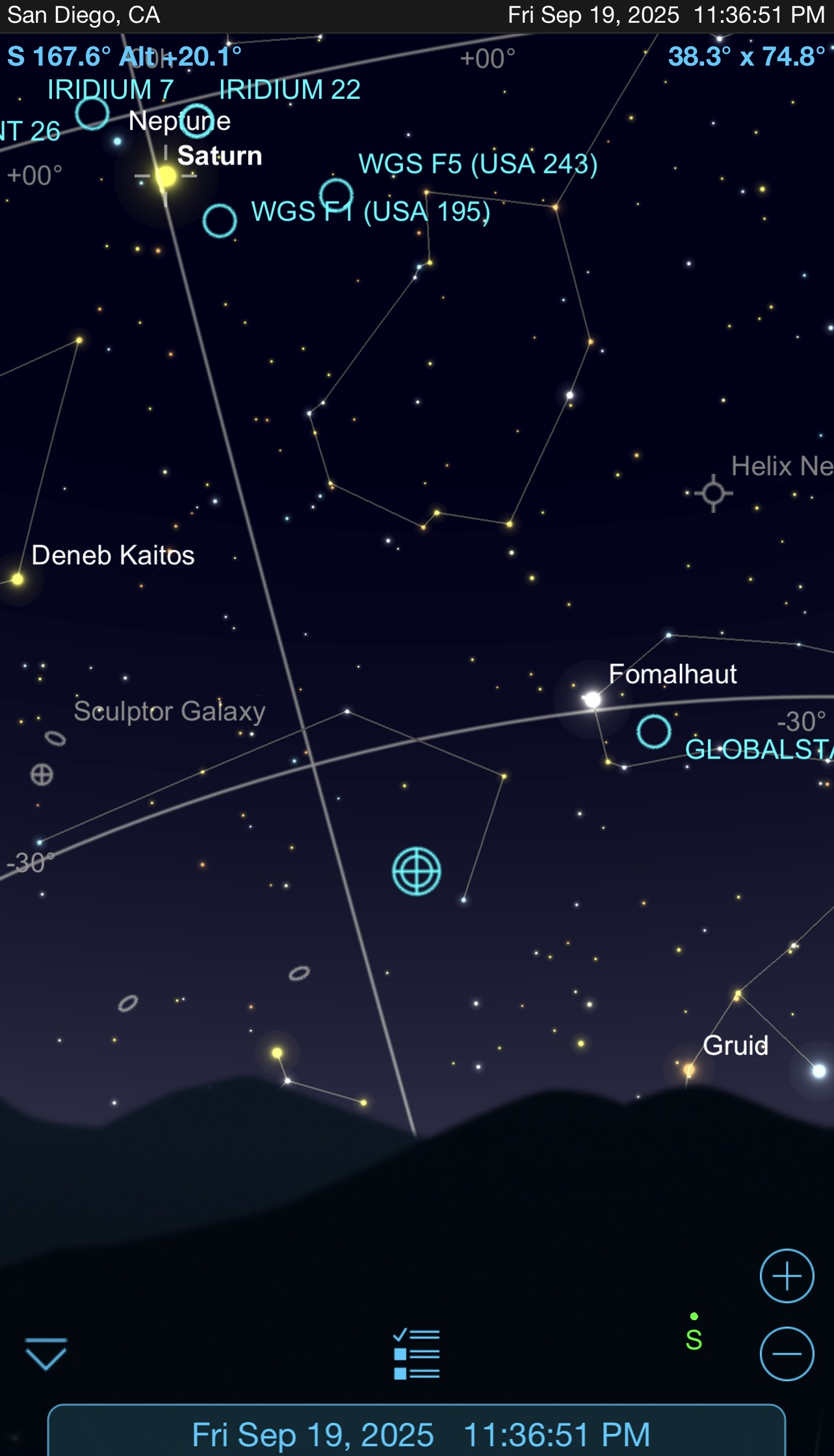
Saturn is in a pretty dull part of the southern sky. There are few bright stars. At 11:00p or so Saturn is a little west of south about halfway up the sky. It's bright (but not as bright as it can be when the rings are at fuller tilt, reflecting more sunlight). Further south of it is the brightest star in the region, Fomalhaut.
Note: spend $2.99 and get Sky-Safari on your phone. Search for "Saturn" and select Locate. SkySafari will point your phone at Saturn.
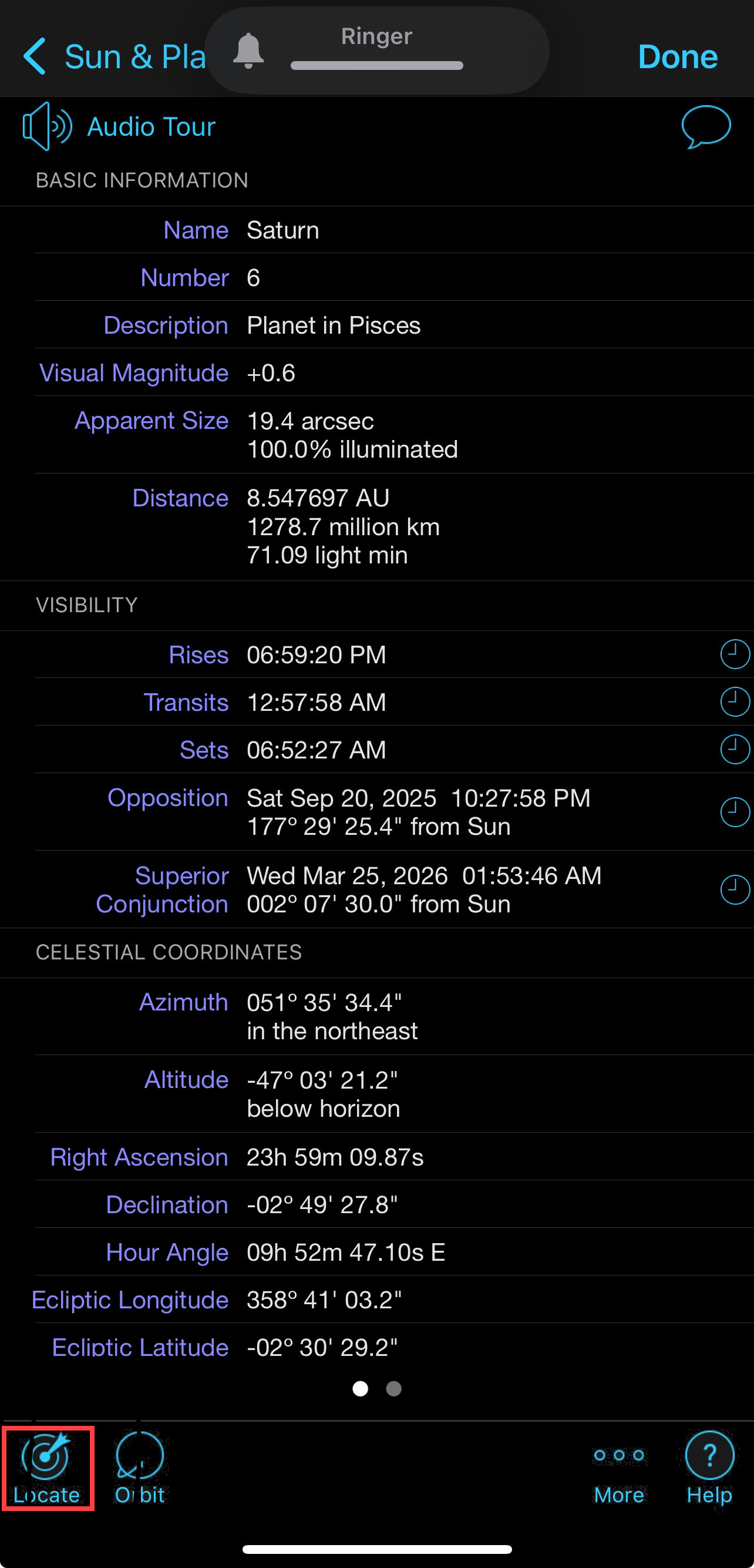
Note, that if you see "Center" as opposed to "Locate" that means the Compass setting needs to be turned on.