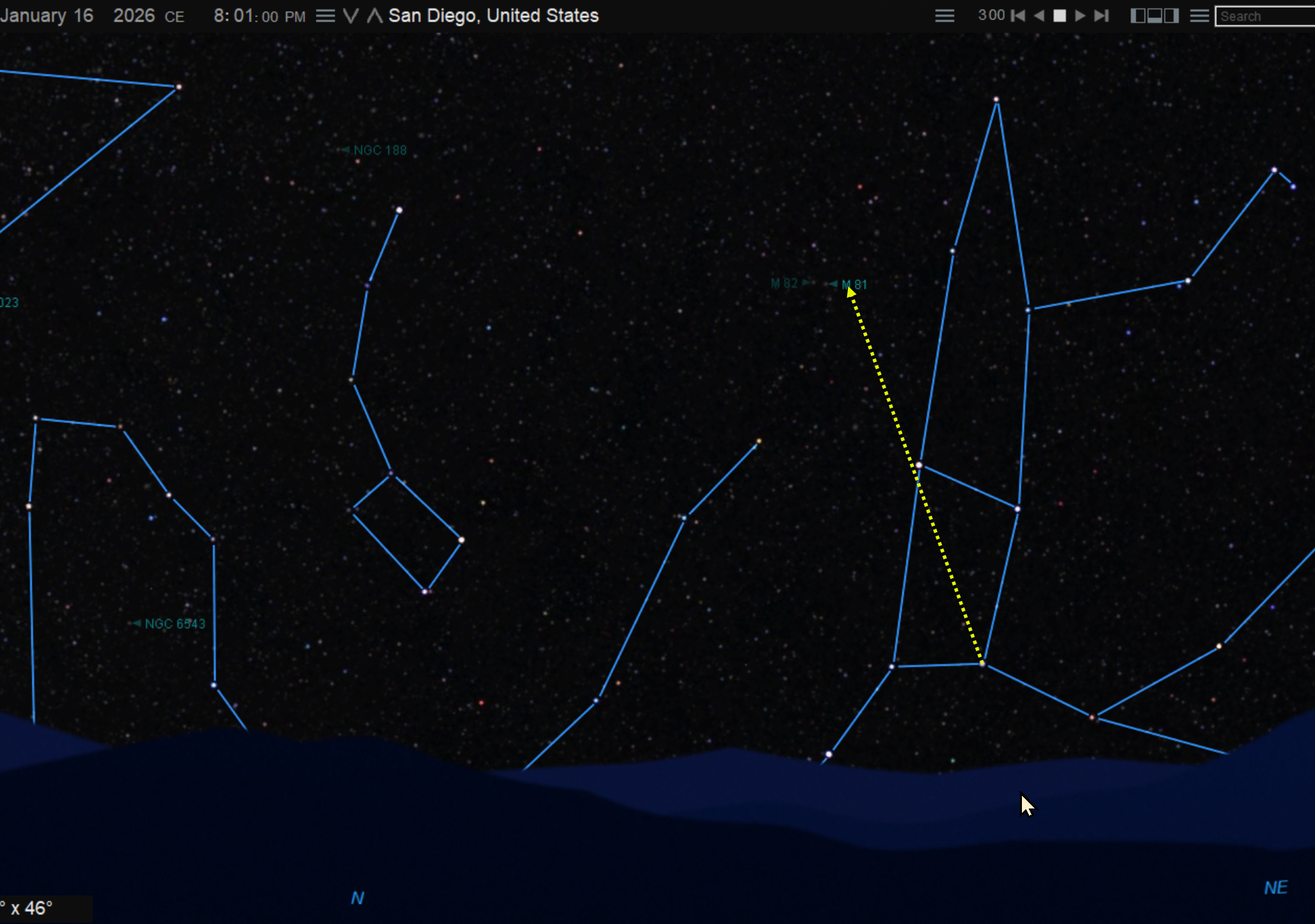
On the evening of Jan 17 (and 18), the sky from San Diego will have no moon, but lots of planets.
Dress Warm - sitting still in the cold night at a telescope is very chilling. Bring the warmest clothes you can.
White flashlights and other lights will ruin your night vision. Red lights, red flashlights, red headlamps allow you to see without ruining your night vision. In about twenty minutes in darkness your eyes become very sensitive to faint light: Night Vision! Bright lights reset that timer.
Merit Badge info: Scouting Astronomy Merit Badge
Observing Plan
(Note: I originally had the wrong dates (Friday and Saturday). The actual dates are Saturday and Sunday (Jan 17 and 18 - I'll replace the Saturday information with Monday shortly).
here's a Target Checklist: 260117-Target Checks
There will be lots of scopes. You'll likely get to point one. Jupiter is the brightest "star" in the sky. It's great practice pointing a scope (it's a learned skill (because a telescope's field of view).
Go out tonight and look to the East. That big bright "star" is Jupiter. If you have binoculars, take a look. What do you see?
Orion's Nebula is a great "Deep Sky Object" - AND it's visible from city skies. It's a featured attraction in the winter. You'll want to know where to find it. On the How To Starhop page, instructions are there for the Orion Nebula. See if you can find the spot the location from home (try after 8:00pm).

At Agua Caliente campground, the mountains block the west and southwest, so Saturn should be a first target. The rings are edge-on, so this will be the least amazing Saturn ever looks. You'll see a ball with a line extending through it. Still worth a look.
Andromeda - The nearest big galaxy and the farthest object you can see with your naked eye (4 million light years). It will set behind the mountains early, so get to it.
Neptune. Forget about it. It is indistinguishable from the stars in any of the telescopes we're bringing (even the 16-inch).
Uranus. This will show as a green ball, not much bigger than the background stars, except that it definitely looks like a ball, not a point. See and be able to brag to your friends.
Jupiter. Jupiter is pretty much always amazing and it's in the sky from dusk until almost dawn. And we're close to it. A great night for Jupiter.
Here's what it will look like on Friday night (timestamp on the top of the video). You can see this from very bright skies.
Jupiter rotates once every 9 hours - crazy fast. On Friday January 16, as it's getting dark the Great Red Spot has just "risen" (rotated into view). Over the next couple of hours, you'll see it move west across the face of Jupiter. If you watch until dawn, you'll see it rise again.
Note: it is not very red - it's kind of salmon-colored - and it doesn't stand out very clearly from the storm band it's embedded in. I didn't see it for years until the Southern Equatorial Belt disappeared for a few months (it does that occasionally). The Spot definitely stands out against the white cloud background.
Here's what Jupiter will look like on Saturday Night:
Did you see the cool things that happen? But very early in the morning.
The secret spectacle that hopefully none of the campers are awake for: Io Shadow Transit and Callisto hide
Jupiter Sunday night:
Great Red Spot rolls into view at around 6:30 and 4:20a. A few minutes after midnight, Io ducks behind Jupiter and reappears at around 2:25 am.
The Orion Nebula is in prime position once it's dark.
Note: everything mentioned above is visible from cities. As in tonight (well, the planets move around and the moon transits occur at different times - but the objects are bright enough to be see with inexpensive telescopes or binoculars).
Looking west/northwest (again, at Agua Caliente, low west is blocked):
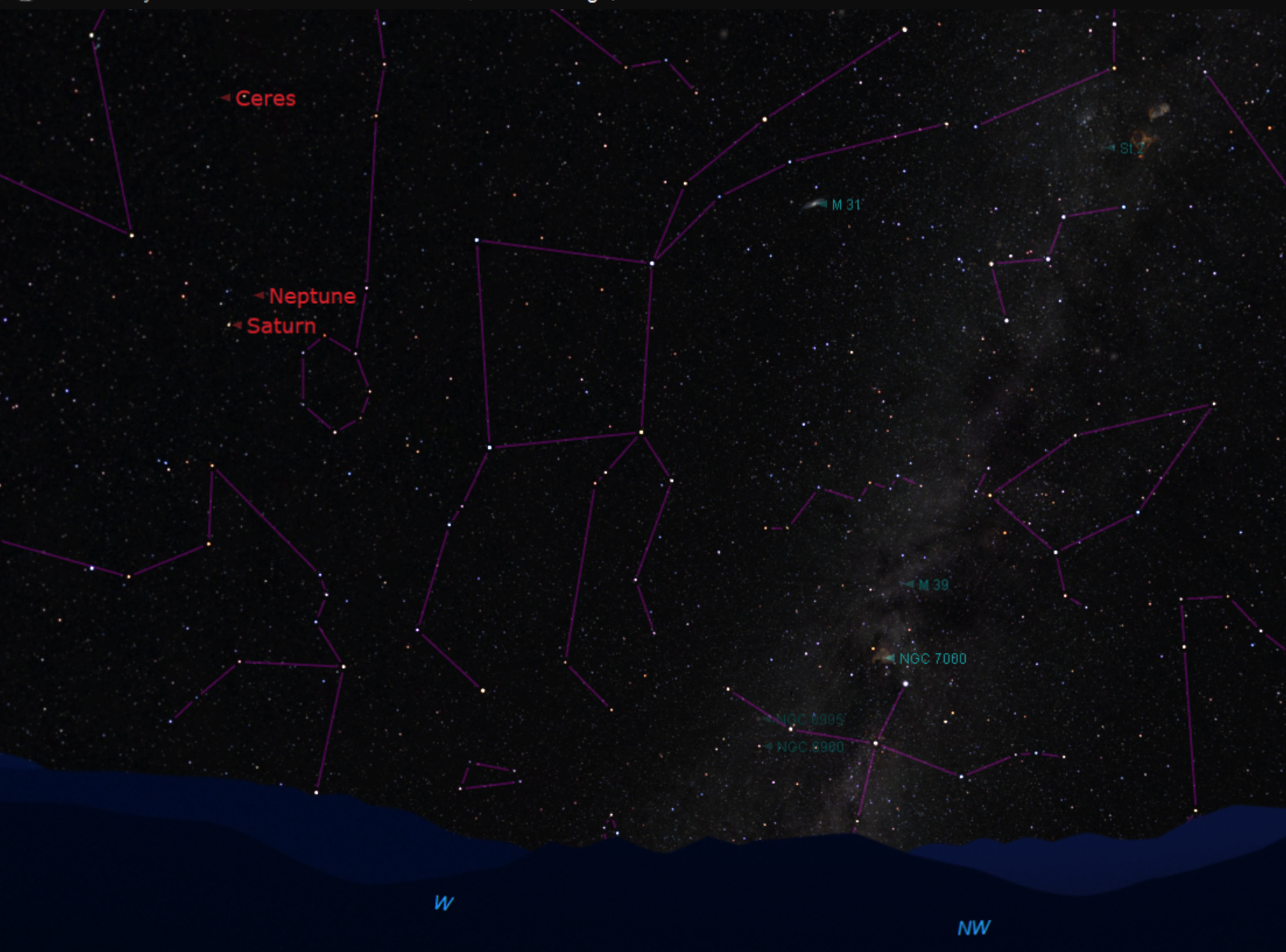
January looking Northwest
You get some Milky Way. Sweep a scope through here.
After 7:30p or so, you should be able to use two of the stars in the Big Dipper "bowl" to find two really cool galaxies, M81 and M82 (Bode's Galaxy and the Cigar Galaxy (or Exploding Galaxy). Draw a line between the two stars and go that distance again. With low power you should be able to find them. One is face-on and the other is edge-on